Specialist Group in Tectonics and Structural Geology
2026 Meeting
9-13 November 2026
Email: SGTSG2026@gmail.com


Mid-conference field trip
Ross Cayley & Alanis Olesch-Byrne
This full-day field trip will introduce delegates to a series of exceptional field localities across central Victoria, highlighting Ordovician deep-marine turbidites, fold-and-fault architecture, Permian glacial pavements, granite carapace textures, and structures associated with Victoria’s orogenic gold systems.
The excursion will depart from the Ballarat Goods Shed at 7:30 am and return in the early evening. Travel will be by coach.
Proposed itinerary
7:30 am – Depart Ballarat Goods Shed
Delegates will travel northeast from Ballarat towards Lake Eppalock, via Daylesford, Malmsbury, Redesdale and the surrounding central Victorian goldfields landscape.
SITE 1
9:10 am – 11:10 am | Site 1: Lake Eppalock emergency spillway
The first stop examines Ordovician Castlemaine Group deep-marine meta-turbidites exposed in the Lake Eppalock emergency spillway. The site includes an outstanding late Ordovician anticline hinge exposure, abundant sedimentary structures, refracted slaty cleavage, quartz tension-vein arrays, brittle faults, kink folds, breccias, hydrothermal alteration and structures relevant to orogenic gold mineralisation.


Figure caption: The Anticline and associated structures.


Figure caption: Fe-Ca Selveges around quartz mineralisation.
Figure caption: Subvertically dipping drag folds adjacent to late strike slip faults
11:10 am – 11:30 am | Transfer to Site 2
SITE 2
11:30 am – 1:00 pm | Site 2: Lake Eppalock north shoreline glacial pavements
A short walk along the lakeshore leads to some of Victoria’s best Permian striated glacial pavements, carved into Ordovician Castlemaine Group bedrock. Delegates will view multiple generations of glacial striations, asymmetric gouge and chatter marks, in-situ Permian tillite of the Bacchus Marsh Formation, and additional Ordovician structures including bedded dip-slip faults with quartz slickensides and stepped vein overgrowths.


Figure caption: Permian glacial pavements and associated glacial tillite

Figure caption: striated quartz erratics in the tillite

Figure caption: in-situ glacial pavements


Figure caption: in-situ glacial pavements
1:00 pm – 1:15 pm | Transfer to Heathcote
LUNCH
1:15 pm – 2:15/2:30 pm | Lunch stop: Heathcote
Lunch and public toilet stop in Heathcote.
2:15/2:30 pm – 3:30 pm | Transfer to Site 3 via Redesdale
The route to Site 3 includes a short stop at the historic Redesdale Bridge, subject to coach height. Public toilets are available in Redesdale if required.
SITE 3
3:30 pm – 4:45/5:00 pm | Site 3: Bell-Topper Hill, near Malmsbury
This stop examines the Devonian Missing Link Granite, including accessible examples of unidirectional solidification textures in a pluton carapace, sheeted vein complexes, and the transition into the main granite body. The locality provides an excellent opportunity to discuss the realities of geological mapping in central Victoria, where cryptic outcrop can preserve highly significant structural and magmatic features.


Figure caption: UST's in the carapace of the Missing Link Granite at Belltopper Hill
Additional geological context: Bell-Topper Hill
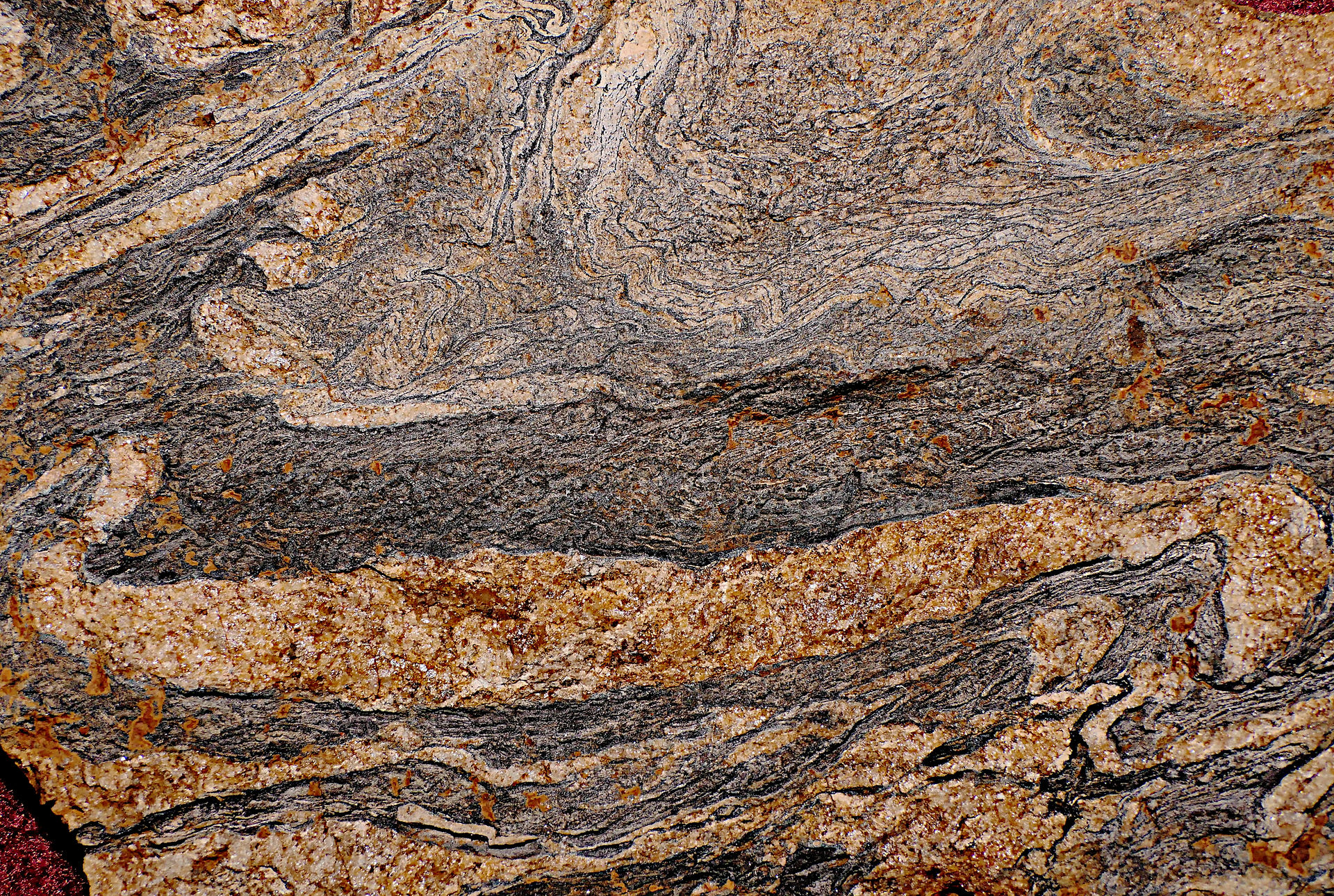
The Bell-Topper Hill locality includes contorted, heterogranular unidirectional solidification texture, or UST, development. These textures comprise multi-banded, inward-growing quartz crystal layers nucleated along subparallel geochemical interfaces close to the upper contact of the intrusion. The repeated precipitation episodes are interpreted to reflect episodic pressure drops and induced fluid boiling during crystallisation. The distinctive wavy or “brain-like” appearance of the textures is attributed to post-crystallisation distortion of the crystal mush, producing a highly unusual and visually striking outcrop expression.


Figure caption: these are type f - contorted heterogranular, from Muller et al., 2023
Figure caption: UST
Figure caption: UST
4:45/5:00 pm – 6:00 pm | Return towards Ballarat
SITE 4
Approx. 6:00 pm – 6:20 pm | Site 4: Norman Street road cuttings, Ballarat North
The final stop brings the excursion back to Ballarat geology. The Norman Street road cuttings expose Ordovician turbidites, a fold closure, faulting, quartz veining and a breached anticline quartz lode style comparable to structures mined in the Ballarat goldfield. This accessible locality provides a fitting conclusion to the day and may be revisited independently by delegates during the conference.


Figure caption: Norman Street Road cutting (from Google Streetview)
Approx. 6:20–6:40 pm | Return to Ballarat Goods Shed
Final return time will depend on traffic, coach access, and the duration of the Norman Street stop.